Crime & Law
Judge Weighs Bid to Overturn Notorious Murder Conviction in 1992 Killing of 7-Year-Old Boy Amid Torture Claims
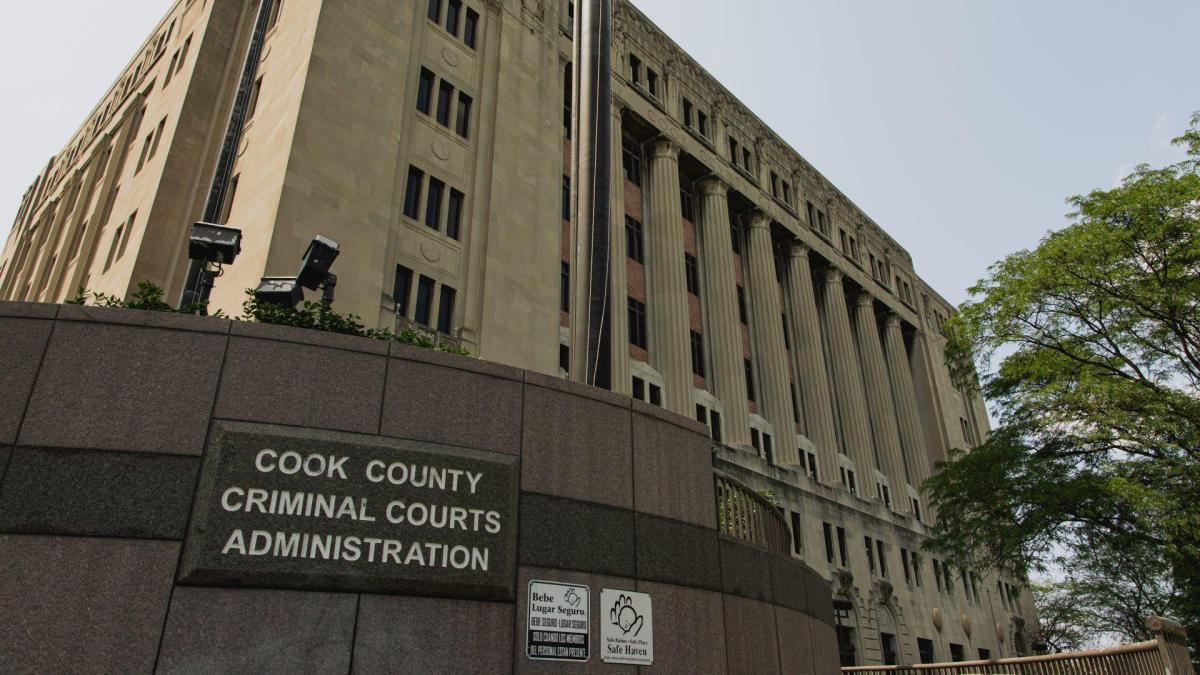 Leighton Criminal Court Building (Michael Izquierdo / WTTW News)
A Cook County judge is weighing whether to overturn a conviction in one of the most notorious murders in Chicago history after hearing closing arguments on Monday.
It is now up to Circuit Court Judge Adrienne Davis to decide whether there is enough evidence to uphold the conviction of Anthony Garrett in connection with the murder of 7-year-old Dantrell Davis, who was shot and killed by a sniper at Cabrini-Green in 1992 as he and his mother walked to school.
Judge Davis will not rule before a July 14 hearing.
Garrett’s attorneys and Cook County prosecutors laid out their respective cases during Monday’s hearing at the Leighton Criminal Courts Building.
Dantrell’s killing outraged the city and became a symbol of the gang violence plaguing Chicago and the city’s notorious public housing. In 1992, 936 people were killed in Chicago, setting a record that still stands. By comparison, 420 people were killed in 2025.
Garrett said he confessed after then-CPD Detective Richard Zuley and other detectives beat him on at least two occasions with rubber hoses and a phone book on his torso, genitals and legs, court records show.
Garrett later recanted his confession.
“We have proven torture by a preponderence of evidence,” Garrett’s attorney Jennifer Blagg argued Monday.
Beyond just a new trial, Garrett is also seeking a certificate of innocence.
But prosecutors argued Garrett’s alibi at the time of the shooting didn’t hold up and his claims of severe leg injuries caused by his beating while in police custody were disputed by medical experts who testified in this case.
Zuley testified during Garrett’s 1994 trial that he confessed to accidentally shooting the boy while firing at rival gang members from the 10th floor of a high-rise apartment building.
The weapon used to kill Dantrell was never found, gun powder residue was not found on Garrett’s clothing, and no one testified they saw Garrett kill the boy, court records show.
Garrett said he was not informed of his rights or given access to an attorney before he was interrogated in a small windowless room, where he was denied access to the bathroom and prevented from lying down to sleep for more than 24 hours, court records show.
Garrett was convicted and sentenced to 100 years in prison.
In February, Zuley testified that he did not coerce Garrett into confessing. But Blagg argued Zuley came up with a narrative, then wrote things in his reports after the fact to fit that narrative.
“This investigation is a joke,” she said. “What happens is they target this man, they beat him until he confesses and the case is closed, despite all these loose ends.”
In 2023, the Illinois Torture Inquiry and Relief Commission found that there was “sufficient, credible evidence” that Garrett was tortured by Zuley, and urged that a Cook County judge review his conviction.
While the former detective has denied coercing Garrett’s confession, “there is strong reason to distrust Detective Zuley’s accounts of what transpired in light of his incontrovertible pattern and practice history of allegations of torture,” the commission concluded.
That finding relied, in part, on testimony that Zuley tortured a Mauritanian man being held in a U.S. military prison at Guantánamo Bay in the wake of the Sept. 11 attacks. A member of the U.S. Naval Reserve, Zuley was sent to Guantánamo after the terror attacks.
Mohamedou Ould Slahi, who was held for 14 years, without charge or trial, in the U.S. detention camp at Guantánamo Bay, Cuba, testified that Zuley tortured him, nearly killing him.
“He told me ‘I don’t give a f--- about fairness or justice, I care about saving lives,’” Slahi testified during the hearing into Garrett’s conviction. “I had no answer for him.”
The U.S. Senate report on torture at Guantánamo Bay identified Zuley as the official responsible for ordering the tactics designed to make Slahi confess to participating in terror attacks, including “hooding, sensory deprivation (and) sleep deprivation.”
Cook County State’s Attorney Eileen O’Neill Burke, who opposes a new trial for Garrett, urged Davis not to consider Slahi’s testimony during her deliberations because Zuley was not permitted by federal officials to testify about his conduct at Guantánamo Bay.
And prosecutors on Monday argued that Slahi’s claims have nothing to do with Garrett’s guilt or innocence.
But Blagg said that like Slahi, Garrett falsely confessed after Zuley beat him and prevented him from sleeping, establishing “a pattern and practice” of torture by Zuley.
She said Slahi’s testimony is important to Garrett’s case because it showed what happened when Zuley’s “sadistic mind is able to go free.”
Davis denied the state’s request Monday, finding O’Neill Burke’s office had ample time to secure permission for Zuley to testify about his time in Guantánamo Bay and should have brought its concerns about that testimony forth months earlier.
“The state had every opportunity to make these arguments long ago,” the judge said, “and did not do so.”
Chicago taxpayers have paid $13.5 million to resolve two lawsuits claiming two men spent decades in prison after being wrongfully convicted of murder based on evidence developed by Zuley.
Another lawsuit remains pending, records show.
Zuley also served on the task force investigating the 1993 murder of seven employees at a Palatine Brown’s Chicken and Pasta and identified an informant who Zuley said identified the killer. That evidence was discredited after DNA evidence identified two other men in the slayings, and they were convicted.
Zuley, who joined CPD in 1970, collects an annual city taxpayer-funded pension of $96,459. Despite his extensive record of misconduct, Zuley has banked more than $1.4 million in pension payments since he retired, according to records obtained by WTTW News through a Freedom of Information Act request.